


 Cart
Cart
 sales@molnova.com


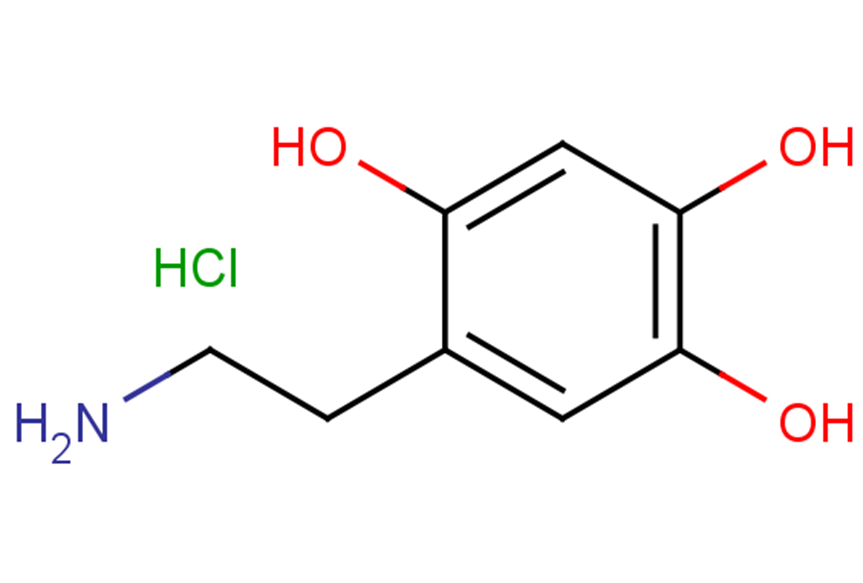
Oxidopamine hydrochloride
CAS No. 28094-15-7
Oxidopamine hydrochloride( 6-Hydroxydopamine hydrochloride,6-OHDA hydrochloride )
Catalog No. M22428 CAS No. 28094-15-7
Oxidopamine hydrochloride is an neurotransmitter dopamine antagonist.
Purity : >98% (HPLC)
 COA
Datasheet
HNMR
HPLC
MSDS
Handing Instructions
COA
Datasheet
HNMR
HPLC
MSDS
Handing Instructions
| Size | Price / USD | Stock | Quantity |
| 5MG | 35 | In Stock |


|
| 10MG | 53 | In Stock |
|
| 25MG | 95 | In Stock |
|
| 50MG | 160 | In Stock |
|
| 100MG | 245 | In Stock |
|
| 200MG | Get Quote | In Stock |
|
| 500MG | Get Quote | In Stock |
|
| 1G | Get Quote | In Stock |
|
Biological Information
-
Product NameOxidopamine hydrochloride
-
NoteResearch use only, not for human use.
-
Brief DescriptionOxidopamine hydrochloride is an neurotransmitter dopamine antagonist.
-
DescriptionOxidopamine hydrochloride is an neurotransmitter dopamine antagonist.
-
In VitroCell Viability Assay Cell Line:Neuro-2a cells and SH-SY5Y cells Concentration:0-500 μM Incubation Time:24 or 48 h Result:Induced neurotoxicity, caused cytotoxicity in both Neuro-2a cells and SH-SY5Y cells in a concentration dependent manner. EC50=111 μM for 24 h incubation and 109 μM for 48 h incubation in the Neuro-2a cells; EC50=118 μM for 24 h incubation and 107 μM for 48 h incubation in the SH-SY5Y cells.RT-PCR Cell Line:Neuro-2a cells and SH-SY5Y cells Concentration:75 or 150?μMIncubation Time:0, 6 or 24 h Result:Quickly and robustly induced COX-2 in a time-dependent manner. Induced COX-2 activation characterized by expression induction and nuclear translocation. Substantially increased PGE2 in the culture medium by nearly 5-fold in Neuro-2a cells (at 75 μM) and 3-fold in SH-SY5Y cells (at 150?μM). Significantly upregulated the pro-inflammatory cytokine interleukin-1β (IL-1β) within Neuro-2a cells and SH-SY5Y cells.Apoptosis Analysis Cell Line:PC12 cells Concentration:0, 25, 50, 75, and 150 μM Incubation Time:0, 2, 4, 6, 12, and 20 h Result:Induced apoptosis of PC12 cells. Increased the activities of caspase-3, -8 and -9 in PC12 cells in a time- and concentration-dependent manner. Increased these caspase activities at 2-4 h and reached a maximum at 12 h. Decreased cells with high mitochondrial membrane potential (JC-1 aggregate) in a time- and concentration-dependent manner.Western Blot Analysis Cell Line:PC12 cells Concentration:75 μM Incubation Time:0, 3, 5, 6, 8, 10, and 12 h Result:Increased the level of p-p38 in a time-dependent manner.
-
In Vivo——
-
Synonyms6-Hydroxydopamine hydrochloride,6-OHDA hydrochloride
-
PathwayGPCR/G Protein
-
TargetDopamine Receptor
-
Recptordopamine
-
Research Area——
-
Indication——
Chemical Information
-
CAS Number28094-15-7
-
Formula Weight205.64
-
Molecular FormulaC8H12ClNO3
-
Purity>98% (HPLC)
-
SolubilityDMSO:32 mg/mL (155.61 mM)
-
SMILESCl.NCCc1cc(O)c(O)cc1O
-
Chemical Name——
Shipping & Storage Information
-
Storage(-20℃)
-
ShippingWith Ice Pack
-
Stability≥ 2 years
Reference
1. Fujita H et al. Cell-permeable cAMP analog suppresses 6-hydroxydopamine-induced apoptosis in PC12 cells through the activation of the Akt pathway. Brain Res. 2006 Oct 3;1113(1):10-23.
molnova catalog



related products
-
Talipexole dihydroch...
Talipexole dihydrochloride is a dopamine D2 receptor agonist, α2-adrenoceptor agonist, and 5-HT3 receptor antagonist in both rat cortical and intestinal membrane fractions with Ki values of 0.35 μM and 0.22 μM, respectively. It displays antiParkinsonian activity.
-
Docosahexaenoic acid...
Docosahexaenoic acid ethyl ester (Ethyl docosahexaenoate) enhances 6-hydroxydopamine-induced neuronal damage by inducing lipid peroxidation in the mouse striatum, and can be used to study oxidative diseases of the retina or neurons.
-
GR 103691
GR 103691 is a potent, selective dopamine D3 receptor antagonist (Ki: 0.4 nM).?
